Zapier is brilliant. I mean that. It connects thousands of apps, it is easy to get going, and for plenty of jobs it is exactly the right tool. If you want a new form entry to land in a spreadsheet, or a Slack message when someone books a call, use Zapier and get on with your day.
Keeping ServiceM8 and GoHighLevel in step with each other is not one of those jobs. And the reason comes down to one word: memory.
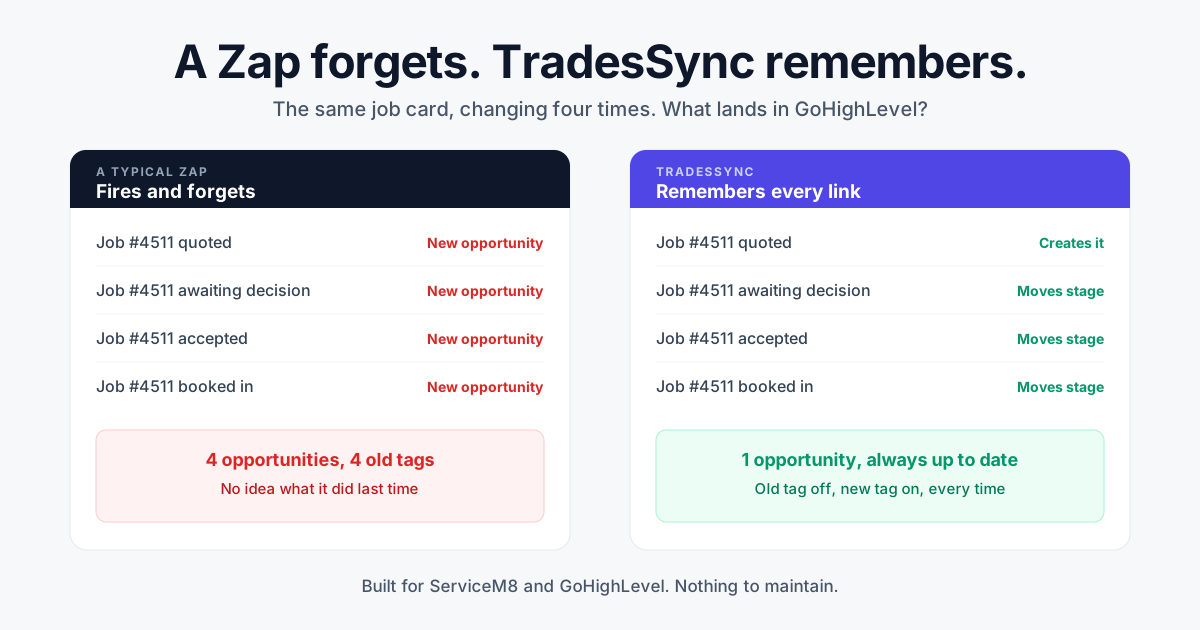
A Zap fires and forgets.
A typical Zap works like this. Something happens in one app, so it does something in another. A job changes in ServiceM8, so it creates something in GoHighLevel. Job done, Zap finished.
The next time that same job changes, the Zap has no idea it has ever seen it before. It does not know there is already an opportunity for it. It does not know which tag it put on the contact last time. It does not know which stage the job was sitting in yesterday. Every run starts from scratch.
For a contact, that is mostly fine. For a job card, it is where everything starts to go wrong.
What a job card actually needs.
Think about what one job does over its life. It comes in as an enquiry. It gets quoted. It sits waiting for a decision. It gets accepted, booked in, worked, invoiced and paid. In ServiceM8 that is one job card moving through your queues and statuses.
To mirror that properly in GoHighLevel, every single change needs to:
- find the opportunity that already exists for that job, not create a new one.
- move it to the right pipeline stage.
- take the old queue tag off the contact before putting the new one on.
- cope if someone has deleted the opportunity at the other end.
- leave the customer's details alone if they already exist.
A Zap can be made to do some of that. You add a lookup step to search for the opportunity. You add a filter in case it is not found. You add a path for each queue. You add another Zap for when the status changes rather than the queue. Before long you have a tangle of Zaps, each with several steps, each one depending on the others, and nobody quite remembers how it all fits together.
Where it falls down in real life.
Here is what that looks like in a real business.
An electrician I work with recently spent a week going through his GoHighLevel workflows. He found opportunities being removed from a workflow and then tagged anyway. He found notifications going to the office for jobs that had already moved on. He found a workflow that started from an inbound webhook, put there by an old Zap, which had not fired since January. That workflow was not starting at all, and nobody had noticed.
None of that is anybody being bad at their job. It is what happens when you build memory out of lookups and filters and hope every Zap keeps up with every other one. One step changes, one app updates, one Zap gets switched off, and the whole thing quietly drifts out of line.
There is a cost side too. Every action in a Zap counts as a task, so a single job card moving through five stages can chew through your allowance fast. And on the GoHighLevel side, an inbound webhook is a premium trigger, which carries a charge every time it runs. You end up paying twice to move one job.
TradesSync remembers.
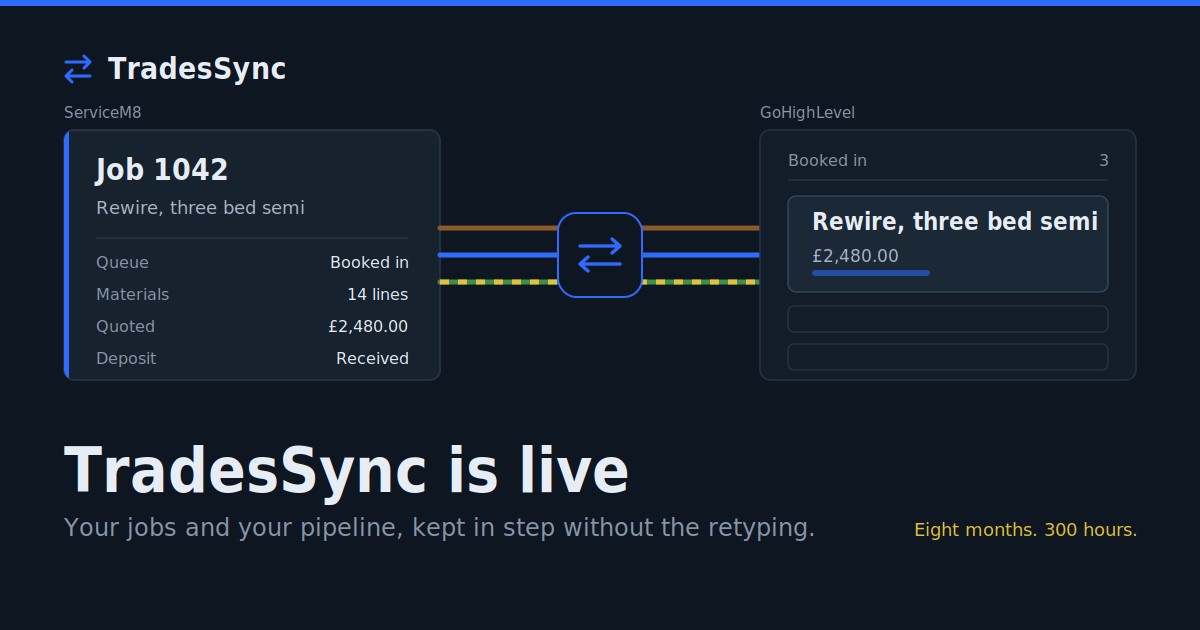
I built TradesSync to do one job and do it properly: keep your ServiceM8 job cards and your GoHighLevel pipeline in step.
The difference is that it keeps a record of every link it makes. Each ServiceM8 client is tied to its GoHighLevel contact. Each job card is tied to its opportunity, and knows which customer it belongs to. So every time something changes, TradesSync knows exactly what it has already done and what needs doing next.
That one record is what lets it:
- update the same opportunity every time instead of creating duplicates.
- move the job through your pipeline as it moves through your queues, statuses or categories.
- swap the queue tag over cleanly, so your tags never pile up.
- pick up opportunities you already had rather than doubling up.
- spot when a job has been moved to a different client, so nobody gets messages meant for someone else.
- put itself right when something has been deleted in GoHighLevel.
- show you a sync log of exactly what it did and why.
It only stores the IDs that link records together, never a second copy of your customers' details.
And because TradesSync moves the opportunity for you, your GoHighLevel workflows can simply trigger on the pipeline stage changing. No webhooks, no premium triggers, no Zaps holding it all together. ServiceM8 does the work, TradesSync keeps GoHighLevel up to date, and your workflows just do the messaging.
One price, nothing to maintain.
TradesSync is a flat monthly price, however many job cards you push through it. There are no tasks to count and no Zaps to babysit. It checks ServiceM8 every five minutes, around the clock, and gets on with it.
If you are running ServiceM8 and GoHighLevel and holding them together with Zapier, have a look at how many Zaps you have, how many steps are in each one, and when you last checked they all still work. If the answer makes you wince, that is exactly what TradesSync was built for.